
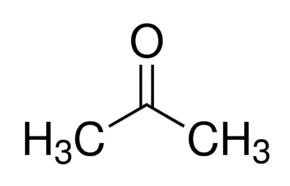
Description
Description
Acetone Residue Analysis ≥99.9% 1 Liter Case/6
- CAS Number 67-64-1
- Linear Formula CH3COCH3
- Molecular Weight 58.08
- Beilstein/REAXYS Number 635680
- EC Number 200-662-2
- MDL number MFCD00008765
- eCl@ss 39021201
- PubChem Substance ID 329760025
- NACRES NA.02
| grade | HPLC Plus |
| for GC | |
| for HPLC | |
| for residue analysis | |
| vapor density | 2 (vs air) |
| vapor pressure | 184 mmHg ( 20 °C) |
| assay | ≥99.9% |
| form | liquid |
| expl. lim. | 13.2 % |
| impurities | ≤0.5% water |
| ≤1.0 ppb Fluorescence (quinine) at 365 nm | |
| evapn. residue | ≤0.0003% |
| halogenated residue | |
| refractive index | n20/D 1.359 (lit.) |
| bp | 56 °C/760 mmHg (lit.) |
| mp | −94 °C (lit.) |
| solubility | water: miscible |
| density | 0.791 g/mL at 25 °C (lit.) |
| λ | H2O reference |
| UV absorption | λ: 330 nm Amax: 1.0 |
| λ: 340 nm Amax: 0.06 | |
| λ: 350 nm Amax: 0.01 | |
| λ: 375-400 nm Amax: 0.005 | |
| Featured Industry | Food and Beverages |
| SMILES string | CC(C)=O |
| InChI | 1S/C3H6O/c1-3(2)4/h1-2H3 |
| InChI key | CSCPPACGZOOCGX-UHFFFAOYSA-N |
General description
Acetone is a ketone. Mixtures of TiO2 (P25) with rare earth oxides (La2O3 or Y2O3) calcined at 700°C or 650°C has been reported to efficiently photocatalyze oxidation of acetone. Its aldol condensation in vapor-phase has been investigated over MgO promoted with alkali (Li, Na, K and Cs) or alkaline earth (Ca, Sr and Ba) metal ions.It undergoes Aldol condensation in the presence of Mg-Al layered double hydroxides (LDH) as catalysts and Cl– and/or CO32- as compensating anions to afford diacetone alcohol and mesityl oxide. Enantioselective Aldol condensation of acetone with various isatins in the presence of dipeptides (catalyst) has been described.
Application
Acetone may be used in the following studies:
• NMR spectroscopic evaluation of glucose metabolism in biological samples (blood).
• Preparation of 13wt% amorphous poly (lactic acid) (PLA) solution, which was required for the preparation of electrospun PLA membranes.
• As a precursor for the synthesis of methyl isobutyl ketone (MIBK) in the presence of sulfonated graphene oxide-Pd/cordierite catalyst.
• Synthesis of (4-hydroxymethyl-2,2-dimethyl-1,3-dioxolane), a solketal from glycerol using supercritical fluids (SCF) technology.
It may be used in the synthesis of the following acetone hydrazones:
• 1-isopropylidene-2-methylhydrazine
• 1-isopropylidene-2-hydroxyethylhydrazine
• 1-isopropylidene-2-formylhydrazine
Acetone′s luminesence intensity is dependent upon the solution components . The absorption of UV light by acetone, results in its photolysis and the production of radials .
Suitable for HPLC, spectrophotometry, environmental testing
GHS02, GHS07
Signal word Danger
Hazard statements H225-H319-H336
Precautionary statements P210-P233-P261-P280-P303 + P361 + P353-P370 + P378
Supplemental Hazard Statements Repeated exposure may cause skin dryness or cracking.
RIDADR UN1090 – class 3 – PG 2 – Acetone
WGK Germany 1
RTECS AL3150000
Flash Point(F) 1.4 °F
Flash Point(C) -17 °C
Documents
Safety Data Sheet
Reviews
There are no reviews yet.