
Description
Description
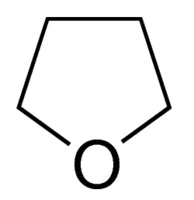
Tetrahydrofuran Contains 250 ppm BHT Puriss. ≥99.9% 1 Liter
Synonym: Butylene oxide, Oxolane, Tetramethylene oxide
- CAS Number 109-99-9
- Empirical Formula (Hill Notation) C4H8O
- Molecular Weight 72.11
- Beilstein/REAXYS Number 102391
- EC Number 203-726-8
- MDL number MFCD00005356
- PubChem Substance ID 329769580
| Quality Level | 200 |
| grade | ACS reagent |
| Reag. Ph. Eur. | |
| vapor density | 2.5 (vs air) |
| vapor pressure | 114 mmHg ( 15 °C) |
| 143 mmHg ( 20 °C) | |
| grade | puriss. p.a. |
| assay | ≥99.9% |
| autoignition temp. | 610 °F |
| contains | 250 ppm BHT as inhibitor |
| ~0.025% 2,6-di-tert-butyl-4-methylphenol as stabilizer | |
| expl. lim. | 1.8-11.8 % |
| impurities | ≤0.001% free acid (as CH3COOH) |
| ≤0.005% peroxides (as H2O2) | |
| ≤0.05% water | |
| evapn. residue | ≤0.001% |
| refractive index | n20/D 1.407 (lit.) |
| n20/D 1.407 | |
| bp | 65-67 °C (lit.) |
| mp | −108 °C (lit.) |
| density | 0.887 g/mL at 20 °C |
| 0.889 g/mL at 25 °C (lit.) | |
| cation traces | Al: ≤0.5 mg/kg |
| B: ≤0.02 mg/kg | |
| Ba: ≤0.1 mg/kg | |
| Bi: ≤0.1 mg/kg | |
| Ca: ≤0.5 mg/kg | |
| Cd: ≤0.05 mg/kg | |
| Co: ≤0.02 mg/kg | |
| Cr: ≤0.02 mg/kg | |
| Cu: ≤0.02 mg/kg | |
| Fe: ≤0.1 mg/kg | |
| K: ≤0.5 mg/kg | |
| Li: ≤0.1 mg/kg | |
| Mg: ≤0.1 mg/kg | |
| Mn: ≤0.02 mg/kg | |
| Mo: ≤0.1 mg/kg | |
| Na: ≤0.5 mg/kg | |
| Ni: ≤0.02 mg/kg | |
| Pb: ≤0.1 mg/kg | |
| Sn: ≤0.1 mg/kg | |
| Sr: ≤0.1 mg/kg | |
| Zn: ≤0.1 mg/kg | |
| SMILES string | C1CCOC1 |
| InChI | 1S/C4H8O/c1-2-4-5-3-1/h1-4H2 |
| InChI key | WYURNTSHIVDZCO-UHFFFAOYSA-N |
General description
The product is tetrahydrofuran (THF) and it contains 250ppm BHT (Butylated hydroxytoluene) as an inhibitor. THF is widely employed as a solvent. It constitutes the key fragment of various natural products (polyether antibiotics). THF forms double hydrate with hydrogen sulfide. Crystal structure of this double hydrate has been investigated by three-dimensional single-crystal studies. Butane-1,4-diol is formed as an intermediate during the synthesis of THF. Hot THF is useful for the dissolution of polyvinylidene chloride (PVDV).
Application
Tetrahydrofuran has been used as a solvent for the preparation of sol-gel solution for coating solid phase microextraction (SPME) fibers in a study.
It may be used for the dissolution of poly-ε-caprolactone (PCL) and 1,3-diaminopentane, during the preparation of poly-ε-caprolactone (PCL)-hydroxyapatite (HA) scaffolds and acrylate-terminated poly(5-amino-1-pentanol-co-1,4-butanediol diacrylate) (C32)- 1,3-diaminopentane (117) polymer, respectively.
Analysis Note
miscible with water and ethanol (96%) pass
Other Notes
GHS02, GHS07, GHS08
Signal word Danger
Hazard statements H225-H302-H319-H335-H351
Precautionary statements P210-P280-P301 + P312 + P330-P305 + P351 + P338-P370 + P378-P403 + P235
Supplemental Hazard Statements May form explosive peroxides.
RIDADR UN 2056 3 / PGII
WGK Germany 1
RTECS LU5950000
Flash Point(F) 1.4 °F
Flash Point(C) -17 °C
Documents
Safety Data Sheet
Reviews
There are no reviews yet.